
Alchemist Artist · Art Stories
The John Osterman Project
John Osterman wanted an empty life. He had mistaken the absence of feeling for peace. When a gap appeared among his beloved dolls, he found a terrible way to fill it.
The artwork behind the story
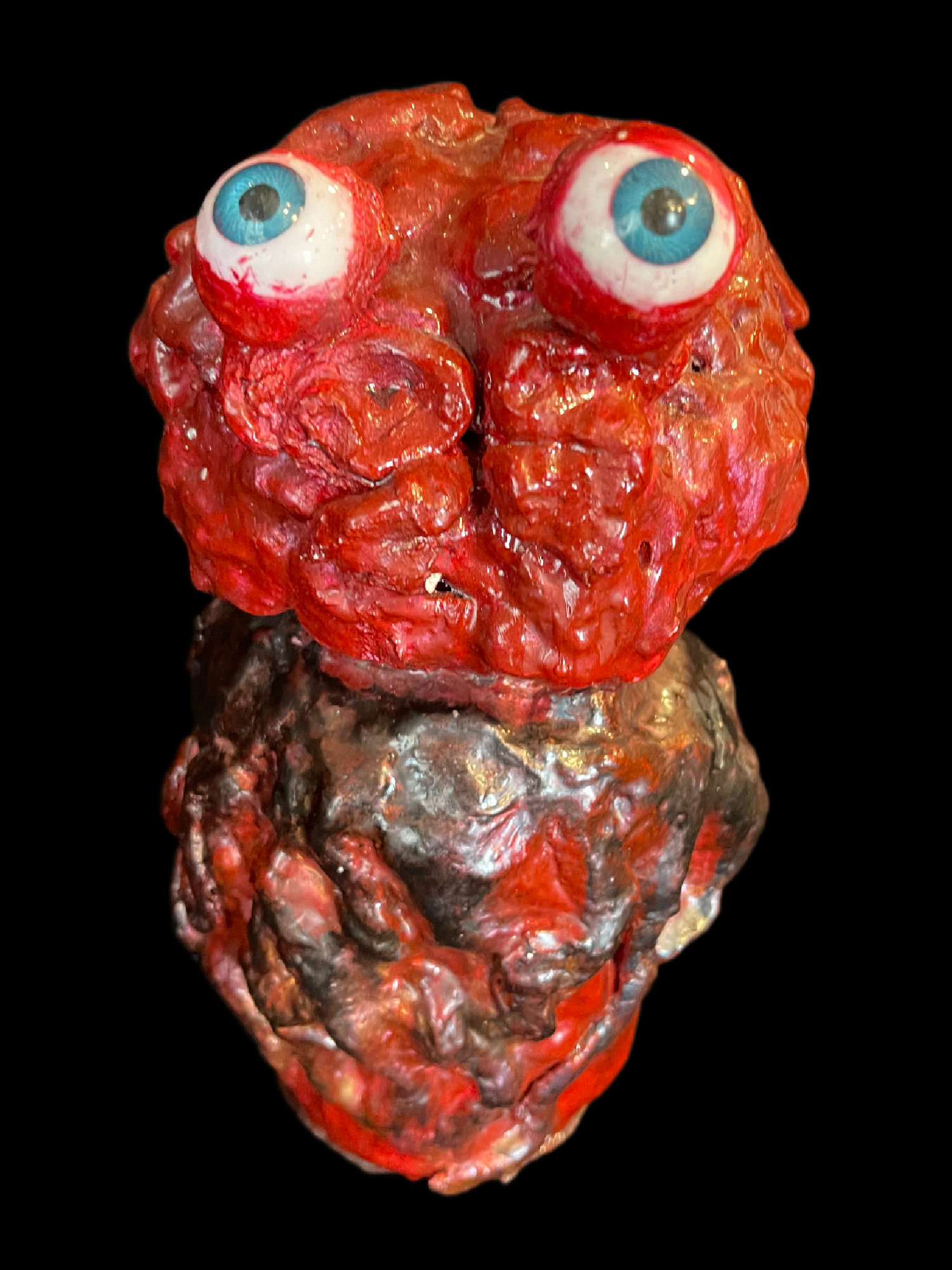
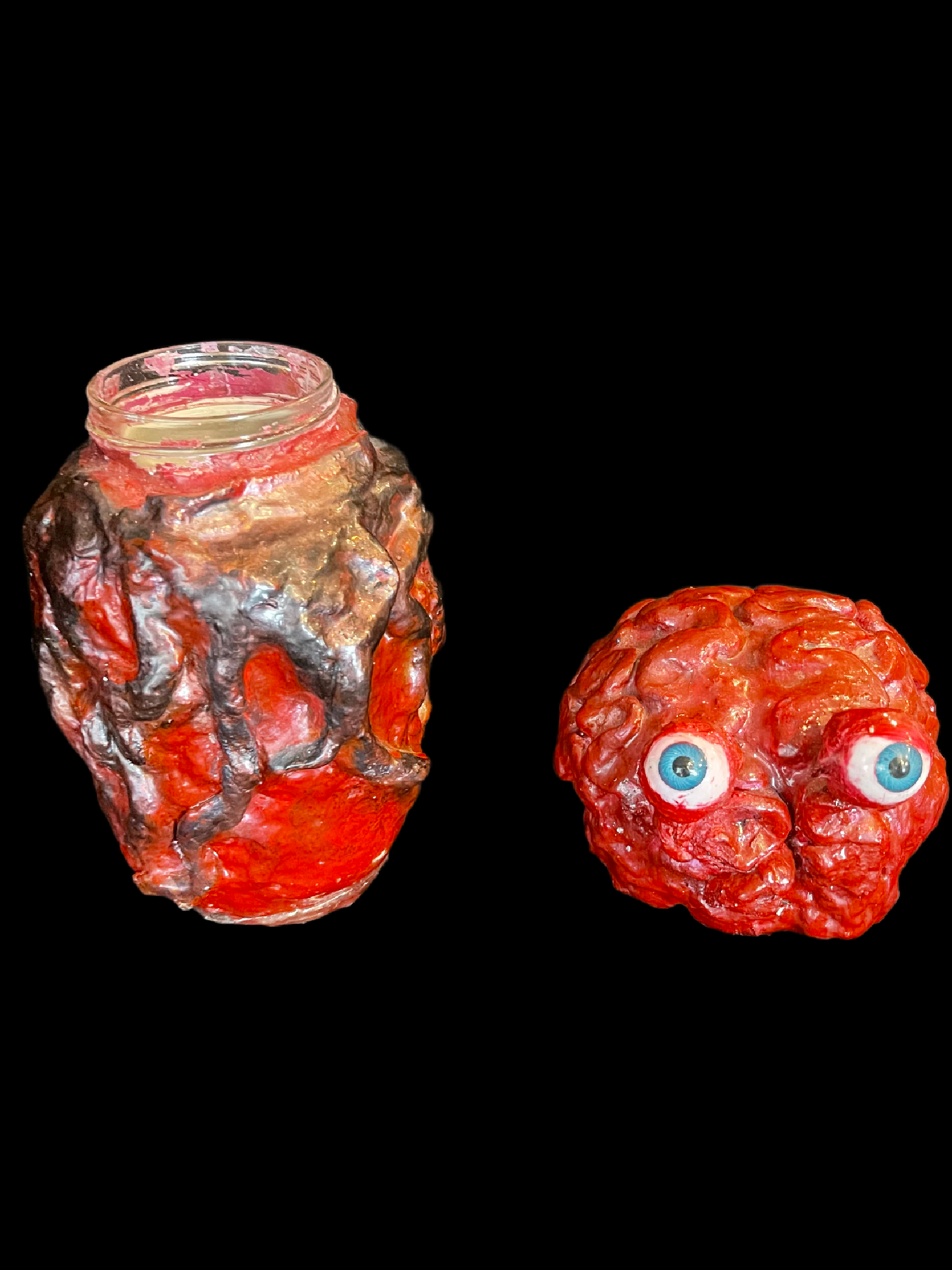
The John Osterman Project brings an imagined creature into mixed media sculpture and a stash jar. A brainlike head, glassy eyes and tentacles give the piece an unsettling presence. Its hollow interior becomes part of the story: a place that can hold something, or remain empty.
The fiction below gives that object a former life. It follows an isolated morgue worker whose attachment to his dolls becomes a disturbing transformation.
A life on repeat
Adapted from the original story by Robert Bernhardt
John Osterman was middle aged, though some mornings he felt considerably older. He lived on the outskirts of Kenneth City, close to a dairy farm, and woke at six every weekday. The sun had barely reached the horizon when he began another day at the morgue.
After twelve hours, he returned to a dinner tray and an aging flat screen television. He watched Jeopardy!, guessed incorrectly and ate alone. He had kept that routine for ten years. Perhaps longer. The days were difficult to count when each looked so much like the one before.
His dolls were the exception.
They filled his closet with porcelain cheeks, pastel dresses and polished eyes. Their faces never changed. They asked nothing of him. John could stand before them and feel, for a little while, that everything was exactly where it belonged.
The empty space
At work, John often felt his mind drift away from his body. Voices passed through the room. His hands continued their tasks. The hours moved forward while he watched from somewhere distant, barely present in his own day.
He thought of his dolls: hollow forms with fixed expressions, performing the simple function of being there. Sometimes he envied them.
One evening, while his dinner heated, he opened the closet. A space interrupted the rows of familiar faces.
A doll was missing.
John stared at the gap. He searched, looked again and found the same absence. Something had been taken from the only place in his life that felt complete.
Something to feel
The next morning, the fog of routine had lifted. John felt every inconvenience sharply. His answers were abrupt. His coworkers kept their distance. The missing doll occupied his thoughts with an intensity he could not put aside.
She did not return. Her face followed him into sleep, and the gap waited whenever he opened the closet.
He began to long for his old emptiness. Before the loss, he had moved through the days without this ache. Now he wanted the quiet behind his dolls’ eyes, the stillness inside their porcelain bodies.
The space needed something hollow.
A doll, perhaps. Or a jar.
John’s solution
The idea arrived with a clarity that frightened him less than it should have. John would fill the empty place himself.
He set to work. His eyes grew glassy. His body changed, losing its familiar boundaries as tendrils replaced the shape of the man he had been. He made himself into a vessel, hollow and ready to occupy the space among the things he loved.
In the transformation, his understanding shifted. There had been no stolen treasure. The absence he had been searching was his own. Routine had concealed it, and the dolls had given it a shape he could finally see.
He had wanted change. Now he had become it.
The vessel in your hands
Here is John Osterman: a middle aged morgue worker in the shape of a jar.
His eyes stare beyond you. His thoughts have become tendrils. The body that once carried him through identical days is now a hollow space, waiting to hold something.
Or nothing.
He has become the object he thought he wanted to be. Whether that has brought him peace is another question.
An object with a former life
The story changes the encounter with the sculpture. Its hollow interior becomes a question about emptiness, while its eyes and tentacles carry the suggestion of a person who has become something unfamiliar.
I invite you to look at the jar again after reading. Consider what it might hold, what John believed he could leave behind and whether the transformation gave him what he was seeking.